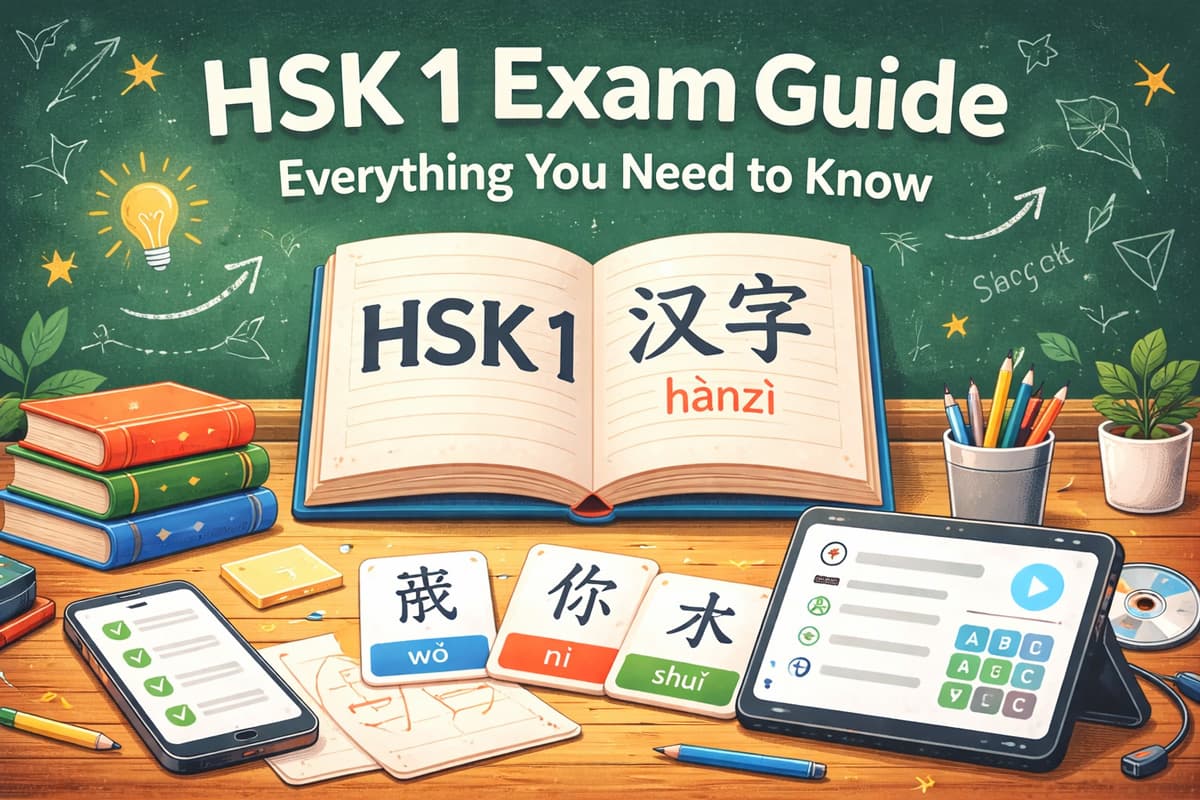
So, you're learning Chinese and keep hearing about this thing called the “HSK.” It sounds official, maybe a bit intimidating, and you're probably wondering if you should take the plunge. Let's break it down. Think of this as your friendly, no-jargon guide to not just surviving the HSK 1, but actually feeling good about it.
So, what exactly is this HSK 1?
HSK stands for Hànyǔ Shuǐpíng Kǎoshì (汉语水平考试). In plain English, it's the official, globally recognized test for Mandarin proficiency.
Level 1 is where everyone starts. It's designed for absolute beginners — the kind of people who have been learning for a few months and can handle the most basic conversations. It's basically the exam that says, “Hey, I've started my Chinese journey, and I can actually say a few things!”
The Exam in a Nutshell: No Writing Required!
Here's the first bit of good news. You don't need to write a single Chinese character! Phew, right? The HSK 1 is all about listening and reading. No essay questions, no stroke-order nightmares.
| Skill | Questions | Time |
|---|---|---|
| Listening | 20 questions | ~15 minutes |
| Reading | 20 questions | ~17 minutes |
| Total | 40 questions | ~40 minutes (incl. personal info) |
You get a score out of 200, and you need 120 to pass. The test is offered in both paper and digital formats. The best part? All the questions have Pinyin above the characters, so you don't need to know the characters by heart — just the sounds and meanings.
What's on the Test? What Do I Need to Know?
The HSK 1 has a very clear curriculum. If you know these two things, you're golden.
1. The 150 Must-Know Words
Your entire world for this exam consists of 150 vocabulary words. That's it! These are the building blocks of everyday Chinese:
| Pinyin | 汉字 | Meaning |
|---|---|---|
| nǐ | 你 | you |
| chī | 吃 | to eat |
| shuǐ | 水 | water |
| shénme | 什么 | what |
These words are the foundation of your Chinese.
2. Basic Grammar Patterns
The grammar is super simple, forming the foundation of everything you'll learn later. You'll need to recognize patterns like:
| Pattern | Example |
|---|---|
| Subject-Verb-Object | Wǒ ài nǐ. (I love you.) |
| Negation with 不 (bù) | Wǒ bú shì lǎoshī. (I am not a teacher.) |
| Asking questions with 吗 (ma) | Nǐ hǎo ma? (How are you?) |
| Showing possession with 的 (de) | Wǒ de míngzì. (my name) |
Let's Peek Inside the Exam: Listening & Reading
Here's a simple breakdown of what each section looks like.
Listening — 4 parts, 5 questions each:
| Part | What you do |
|---|---|
| 1 | Hear a short phrase and see a picture — decide if they match. |
| 2 | Hear a sentence and choose the correct picture out of three. |
| 3 | Hear a short dialogue and match it to the correct picture. |
| 4 | Hear a sentence, then a question about it — choose the right answer from three. |
Reading — 4 parts, 5 questions each:
| Part | What you do |
|---|---|
| 1 | You see a picture and a word — decide if they match. |
| 2 | Read a sentence and choose the picture it describes. |
| 3 | Match 5 questions to their correct answers. |
| 4 | Fill in a missing word in a sentence from a few options. |
Your Game Plan for Success
The HSK 1 is very achievable. Here's how to make it happen.
1. Conquer the Vocab List
Don't just look at the list; interact with it. Make flashcards, use an app, and test yourself regularly. There are only 150 words, so you can definitely do this!
2. Practice Your Listening
The audio for HSK 1 is spoken clearly and a bit slowly. Get used to it by listening to the audio files that come with your textbook or from online sources. Train your ear to pick out the key words.
3. Take a Mock Test
This is a game-changer. A practice test helps you understand the timing, the format, and the style of questions. It also makes you feel much more confident when the real day comes.
The Big Question: Should You Take It?
HSK 1 is perfect for you if:
- You're a total beginner who wants a clear goal.
- You plan to study or work in China one day (this is the first step on that path).
- You just want a formal certificate to prove your first achievement in Chinese!
Even if you don't take the exam, using the HSK 1 framework (vocabulary and grammar) is an excellent, structured way to kickstart your Chinese learning.
So go on, give it a shot. You've got this!
Frequently asked questions
What is the passing score for HSK 1?
The exam is scored out of 200, and you need 120 to pass. The points are split evenly between listening and reading.
Do I need to write characters for HSK 1?
No. HSK 1 only tests listening and reading — there's no writing. And every character has pinyin printed above it.
How many words do you need for HSK 1?
Just 150 words. It's everyday basic vocabulary, and it's very achievable to learn them all.
How long is the HSK 1 exam?
About 40 minutes: 40 questions (20 listening, 20 reading) plus time to fill in your personal details.
How do I prepare for HSK 1?
Learn the 150 words with flashcards, train your ear on clear slow audio, and take a mock test. Blim has HSK 1 flashcards and audio dialogues to practice with.